B2B LinkedIn Creator Marketplaces Compared
Three LinkedIn creator tools solve different problems.
B2B marketers now have three distinct ways to run creator campaigns on LinkedIn, and each one comes with real trade-offs on who you can reach, what you know about their audience, and whether you can prove any of it drove pipeline. That's the actual decision in front of buyers right now, not a hype cycle. B2B influencer spend is growing at roughly 47% year over year, nearly double the pace of the broader influencer industry, according to Moburst's State of B2B Influencer Marketing. LinkedIn's own 2025 B2B Marketing Benchmark with Ipsos found 55% of B2B marketers already run creator programs on the platform, with another 29% planning to start within a year.
The trust math that drives that growth deserves a closer look. LinkedIn and Edelman found in 2024 that 74% of decision-makers trust thought leadership more than product sheets. LinkedIn's 2025 Influence Report with Ipsos put a number on the competitive edge too: expert endorsements are substantially more likely to tip a buyer toward one brand over a rival, compared to branded content alone. And per LinkedIn's 2026 Global B2B Marketing Outlook (YouGov, n=1,299), 77% of B2B marketers say buyers need to already trust and know a brand before they'll engage at all. Creators are becoming the shortcut to that trust. So the real work shifts from deciding whether to run creator programs to building the infrastructure behind them.
What LinkedIn's Creator Marketplace and BrandWorks are, and what they are not
LinkedIn announced two separate products on June 10, 2026, and coverage has tangled them together ever since. They solve different problems.
Creator Marketplace is the software layer. It's a self-serve discovery tool tucked inside Campaign Manager, under a new Content and Assets section. Marketers search vetted creators by topic and content expertise, and each creator card shows followers, post volume, engagement, and recent posts. Click into a "creator insights" view and you get impressions, a full bio, and audience breakdown by industry, job title, and location. Brands can also find organic or sponsored content that already mentions them and push it further with Thought Leader Ads. Reaching out happens the old-fashioned way, by email or LinkedIn profile.
BrandWorks is the managed-service layer, and it's a completely different animal. Instead of a screen you search, it's an internal LinkedIn team of brand, creative, content, and events specialists who build out campaign strategy, creative direction, content, events, and LinkedIn News sponsorships on a client's behalf. It's not generally available. It launched internally in March 2026, and per Reuters, the team grew roughly 60% in the months after. Its predecessor, Top Voices 360, pulled in a substantial sum between May 2025 and May 2026; BrandWorks is aiming for an annualized run rate many times larger next fiscal year, though that's a target LinkedIn has stated, not a number it has delivered. SAP and Webflow are early BrandWorks participants; Top Voices 360 counted SAP, IBM, and ServiceNow among its clients.
Then there's BrandLink, the paid amplification layer, and it's distinct from both of the above. It launched in beta in June 2024 under the name The Wire Program, then rebranded and expanded to include creators as BrandLink in May 2025. It connects brands with publishers and creators through pre-roll video ads that show up in the LinkedIn feed. The publisher list grew in March 2026 to include Axel Springer, The CEO Magazine, NYSE, Reuters Japan, TIME, and Times Network. LinkedIn's own performance data shows BrandLink campaigns get 130% higher average video completion rates than standard in-feed video, and members who see a Lead Gen Form after BrandLink exposure are up to 18% more likely to convert. Revenue jumped nearly 200% quarter over quarter by Q2 2025, and creator and publisher payouts more than tripled year over year. Unlike Creator Marketplace, self-serve BrandLink is already live globally.
There's a creator-led show format riding on top of BrandLink too. Names like Matt Swain, Meagan Loyst, Rachael Higgins, Jon Evans, Rob Mayhew, Ben Francis, Katie Martell, Brandon Smithwrick, and Brendan Gahan are partnering with brands including Adobe, Dropbox, Notion, Mailchimp, and Semrush on branded show formats, including AI in Action, hosted by Allie K Miller.
Put it together and LinkedIn's strategy comes into focus: find creators, amplify what's already working with paid spend, and do all of it inside Campaign Manager without ever leaving the platform.
The real access limits on LinkedIn's native tools today
Here's where the enthusiasm needs a reality check. Creator Marketplace launched in alpha on June 10, 2026, and as of August 13, 2026, it's still limited to select members in the US and Canada, English-language content only.
Creator eligibility isn't automatic, either. LinkedIn's published (and changeable) thresholds require an invitation, plus 12 posts, 5,000 followers, and 45,000 impressions within set 90-day windows. Hitting those numbers doesn't guarantee LinkedIn sends an invite. And even once a creator clears the bar and becomes discoverable, that's not the same as landing brand deals: terms, fit, and the actual decision to work together still happen between brand and creator, off-platform.
BrandWorks is even narrower. It's reserved for select managed accounts, so having a Campaign Manager login tells you nothing about whether BrandWorks is on the table.
LinkedIn hasn't given a timeline for expanding past North America. Right now, organic content discovery and self-serve BrandLink are the only pieces of this stack available worldwide. That leaves a real gap: a subject-matter expert a brand wants to work with, someone with a genuinely credible, engaged professional following, can still sit outside the marketplace entirely because of posting cadence, follower count, recent impression volume, or simply geography.
Jess Phillips, founder and CEO of The Social Standard, described the practical friction directly: "We run B2B campaigns for very large businesses. Getting in touch with B2B creators isn't easy, even when you have their direct email." A discovery tool doesn't solve for creators who have no reason to actively engage with a marketplace listing in the first place. And centralizing discovery this way carries its own risk: it tends to standardize rates for the most visible, already-famous profiles, while leaving niche experts, employee advocates, and consultants with tight, high-trust micro-communities outside the system altogether.
None of this makes the native stack unimportant. It just means it isn't a production-ready solution yet for most global B2B teams, which is exactly the space third-party platforms have moved into.
How third-party B2B creator marketplaces fill the gaps LinkedIn's native tools leave
LinkedIn didn't give outside creator marketing tools any real access until July 8, 2025, when the Member Post Analytics API opened up creator analytics data to a small set of third-party platforms. That single date is basically the founding moment of the third-party category as it exists today.
What do these platforms add that the native tool doesn't?
Global reach, for one, available right now rather than gated behind a North America alpha. Broader creator pools too, including opted-in professionals who'd never clear LinkedIn's follower or impression thresholds but still carry real influence with a tight, relevant audience. Most third-party tools also build audience-fit scoring around actual ICP data, matching by job title, seniority, industry, and company size, rather than LinkedIn's more general demographic snapshot. They handle the operational grind natively: briefs, contracts, content approval, creator payouts, none of which the LinkedIn marketplace touches. And they track attribution across a full campaign, connecting specific posts to clicks, leads, and pipeline, not just impressions or completion rates.
Audience fit is where these platforms actually compete with each other. The pattern that emerges across B2B creator programs is consistent: tightly engaged followers in a specific vertical tend to outperform raw follower volume from generalist audiences. Sam Corrao Clanon, Director of Product at LinkedIn, described the target profile the same way: brands are looking for "subject matter experts and practitioners… that can speak credibly to their experience with your product." That's precisely the criterion audience-fit platforms try to score algorithmically, rather than leaving it to a scroll through follower counts.
Follower count, in other words, is nearly beside the point in B2B. What matters is whether the audience behind a creator actually overlaps with the buyer group a brand is trying to reach. Platforms like Naano build their networks around exactly that kind of vetted access across AI, SaaS, sales, and founder communities, spanning far more geography than LinkedIn's current alpha covers, which makes them a live option for teams that can't sit around waiting for a broader rollout.
The trade-off still costs users the direct line into Thought Leader Ads or BrandLink inventory from inside one interface that third-party tools lack. Third-party tools don't have LinkedIn's built-in amplification loop, no direct line into Thought Leader Ads or BrandLink inventory from inside one interface. Thought Leader Ads can still be set up separately through Campaign Manager, but it's an extra step rather than a single workflow.
Managed-service approaches and when they make sense over self-serve
Managed services cover the whole campaign lifecycle: strategy, sourcing, brief writing, negotiation, content review, compliance, reporting. It's the operational work a self-serve tool might surface but will never actually do for you.
BrandWorks is LinkedIn's version of this, but since it's locked to select managed accounts and isn't a general-market product, external managed-service providers remain the realistic path for most teams that want this level of support. The data suggests the 2025 B2B Influencer Marketing Report found 99% of B2B marketers running an always-on influencer approach rate their programs as effective. That's a strong signal that sustained, managed programs beat one-off campaigns run without dedicated ownership. The same report found 72% of the most advanced B2B influencer teams already have a dedicated budget they expect to grow, which is roughly the profile of a team that finds managed-service spend easy to justify.
So who actually fits where? Managed services make sense for teams without in-house creator expertise, teams that need an always-on content cadence, and organizations running multiple creators and content formats at once where operational overhead, not budget, is the real bottleneck. Self-serve makes more sense for teams with a clear ICP already defined, existing creator relationships, and enough internal bandwidth to handle briefs, contracts, and reporting themselves, or teams still testing the channel before they commit real money to it.
Budget usually isn't the reason B2B creator programs stall out. Brief creation, contract logistics, payout processing, and attribution reporting are. Managed services absorb that weight; purpose-built platforms automate it instead. Neither choice is permanent, and both models can run side by side. Lock-in is the one thing to flag before signing on with any managed offering.
What to evaluate when choosing between these options
Four questions cut across all three models, no matter which one a team is leaning toward.
Start with creator access and pool composition. Are the creators actually needed already in the system, including niche experts, micro-community voices, and international creators? Does the platform surface them based on audience fit with a real ICP, or just by follower count and topic keyword?
Then audience data depth. Can a creator's audience be verified against the actual buyer profile, by job title, seniority, company type, and industry, before any money changes hands? LinkedIn's native tool shows industry, job title, and location. Third-party platforms vary widely in how specific their ICP matching actually gets.
Attribution matters just as much. Does the option trace creator posts to clicks, leads, and pipeline, or does it stop at impressions and video completions? A LinkedIn-Ipsos study found influencer collaboration drives a 39-percentage-point lift in brand awareness, but awareness isn't pipeline. The real question is whether cost-per-lead and revenue attribution are actually available to look at.
And finally, operational lift. What does the internal team have to own directly: brief creation, contract negotiation, content approval, payments, compliance, reporting? Mapping that list against actual internal bandwidth is what separates a good self-serve fit from a team that's about to drown in logistics.
Geography is the fastest filter of all. If the target creators or the internal team sit outside North America, Creator Marketplace's alpha isn't a live option yet, full stop. Self-serve BrandLink and third-party platforms are what's actually available today. Gartner projects 80% of enterprise marketers will fold influencer marketing into their broader mix by 2027, which means whatever infrastructure gets picked now needs to hold up at scale, not just survive a pilot.
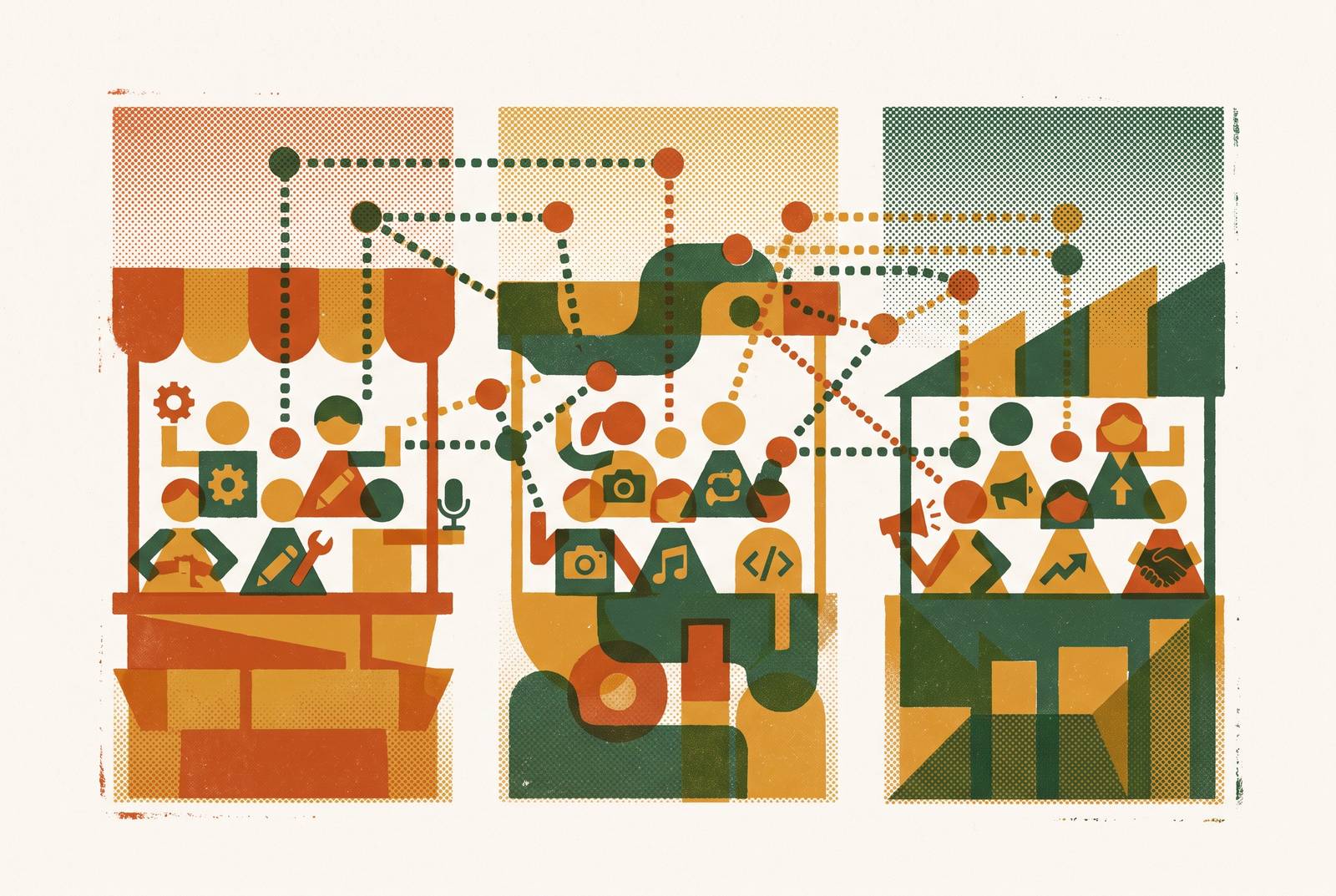
The strongest programs tend to combine pieces from more than one model: audience-fit discovery pulled from a vetted creator network, Thought Leader Ads to amplify whatever organic content is already working, and attribution tools that report on pipeline instead of stopping at reach. As teams move creator programs past the pilot stage, most end up weighing exactly these three infrastructure paths, LinkedIn's native tools, third-party marketplaces like Naano that lean on audience-fit matching and attribution, and fully managed services, and the right call comes down to how much of that operational load, from discovery through payout and pipeline tracking, a team actually wants to keep in-house.
Whatever gets chosen, the same question causes the real test: does this option let a team check a creator's audience against its ICP before spending a dollar, and does it say what that dollar generated in pipeline afterward? Everything else is detail.